Here for veterans and their families
Supporting and advising former members of our UK Armed Forces, reservists and their family members.
Lothians Veterans Centre is a small independent charity which supports military veterans and their families.
We operate a drop-in centre in Dalkeith and have a small team of staff who are readily available to tackle any challenge that arrives through our door.
It is a safe and welcoming environment that can provide instant assistance, support and advice in relation to a wide range of services, including health and wellbeing; housing; employment; benefits; pensions; further education and training; access to health services; welfare; comradeship; and activities.
Veterans can also just drop in for a brew and a chat!
Sometimes there's biscuits!

LATEST NEWS
McCrae’s Battalion Trust’s Annual Pilgrimage to Contalmaison
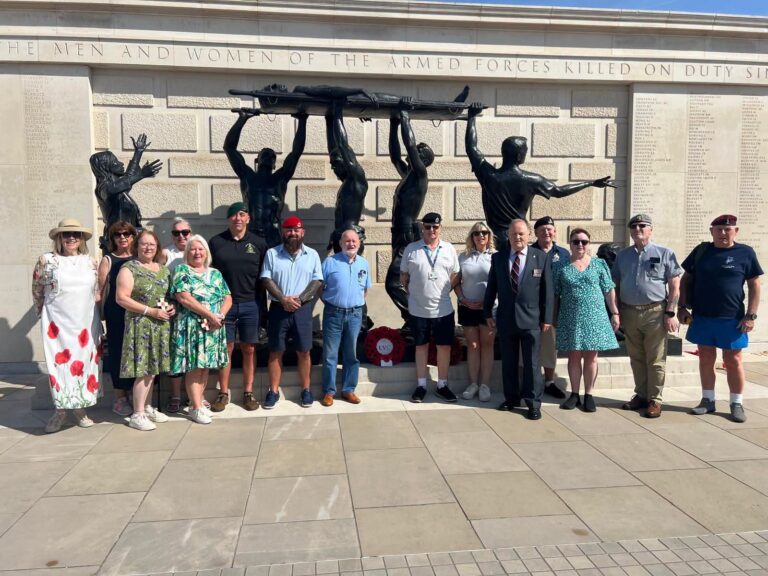
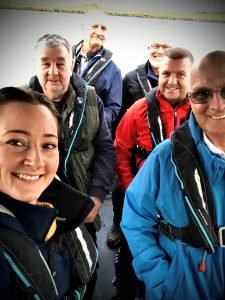
A group of LVC’s staff, volunteers and veterans had the honour and privilege of joining McCrae’s Battalion Trust’s Annual Pilgrimage to Contalmaison from 29th June to 4th July for the 110th anniversary of the Battle of the Somme. We would like to give a special thank you to Jack Alexander and Eddie Dalgleish from the Trust who made us feel so welcome and included from start to finish.
Day 1 consisted of a coach journey to Maidstone for an overnight stay before continuing onwards to Folkestone. There were many familiar faces on the trip along with some new ones, including familiar faces from the Royal Scots Association, members of McCrae’s Battalion Trust, representatives from Hearts, Raith Rovers and Edinburgh Council.
Day 2 began with a coach journey to Folkestone for the Euro Train to Calais. Afterwards the coach took us to our hotel in Amiens, France, where we were able to explore the city, its square and vast array of restaurants and bars. Amien is the capital of the Somme department in the region of Hauts-de-France. The city suffered substantial damage during the great war and was the subject of a fierce battle in 1918 during the opening phase of the successful Allied Hundred Days Offensive leading to the armistice on 11th Nov.
On Wednesday 1st July, the first day of the battle of the Somme 110 years ago and day 3 of our trip, was the journey to the village of Contalmaison and the ceremony. Contalmaison is a small, picturesque village in France surrounded by lush green fields but on 1st July 1916 those fields were anything but peaceful or lush, they were filled with soldiers (many of whom were going over the top for the first time) of the 34th Division of the British Expeditionary Force and at the front was Lieutenant Colonel Sir George McCrae’s Battalion, the 16th Royal Scots – The Pals Battalion. The battalion was made up of players from Heart of Midlothian football team (who were at the top of the league in 1914 when they volunteered), their supporters, players from other teams including Hibernian, Raith Rovers and many other men from the Lothians. On 1st July 1916, the opening and bloodiest day of the Battle of the Somme, British and Commonwealth casualties totalled 57,470. Of that number 19,240 were killed and 2,152 missing or captured. Entire battalions of pals, brothers, neighbours and workmates were wiped out in a matter of minutes. Amid the carnage it was the heroic 16th Royal Scots that penetrated furthest into the German’s defences. Almost three quarters of their fighting strength became casualties, despite this, a small party pressed on to reach the tiny, ruined village of Contalmaison, deep inside the German trench system. In 2004 a commemorative Cairn was raised in Contalmaison to the memory of McCrae’s Battalion. It was constructed by Scottish craftsmen using Scottish materials and has become the centrepiece for Scottish pilgrimages on the Somme ever since. The ceremony culminated in the laying of wreaths and singing the French and British National Anthems. The Royal Scots Standard Bearers Party did well to stand to attention for so long in such a heat! Afterwards an enjoyable afternoon of food, drink, singing, socialising and speeches was had by all at the Salle de Fetes despite the language barrier – thank goodness for Google translate.
Day 4 was our Battlefield tour day which began with a visit to the Sir John Monash Centre at Villers-Bretonneux. We saw the Australian War Memorial and the graves of over 770 Australian soldiers as well as those of other British Empire soldiers. There is a fabulous interactive museum situated here which was opened on 26th April 2015. Following on from this visit we headed to the Grand Mine Lochnagar Crater at La Boisselle. The Lochnagar Crater was formed by a British underground mine being detonated beneath the German front line at 7:28am on 1st July 1916, marking the start of the Battle of the Somme. This single charge contained 60,000lb (27t) of ammonal explosive. The mine created a crater 300ft (90m) across and 90ft (30m) deep, with a rim 15ft (5m) high. The mine was named after Lochnagar Street, the trench from which the tunnelling companies of the Royal Engineers dug the shaft. The explosion was intended to destroy the German strongpoint known as Schwabenhöhe (Swabian Heights) and to provide a tactical advantage for the British infantry. A brief visit was made to the Gordon Dump cemetery, one of the small cemeteries containing the graves of British and British Empire war dead from the Battle of the Somme.
The next stop was the Thiepval Memorial, the Memorial to the Missing of the Somme is a war memorial to the 72,337 missing British and South African servicemen who died in the Battles of the Somme of the First World War between 1915 and 1918, with no known grave. It is near the village of Thiepval, Picardy in France. A visitors’ centre was opened in 2004. Lastly, we visited the village of Albert (or Vill-Bret as the Australians named it) for lunch and a chance to relax after a very poignant morning.
Day 5, our last day in France, entailed a visit to the Spanbroekmolen Crater which has a depth of 88ft and contained 90,000lbs of ammonal. Due to the high-water table of the area Spanbroekmolen quickly flooded and remains so to this day. In the 1920’s the site was purchased and preserved as a war memorial and has been renamed the pool of peace.
We had lunch and spent the afternoon in Ypres. The cloth-producing city of Ypres was almost destroyed during the Great War. Its sensitive reconstruction remains one of the wonders of modern Europe. In many places it’s hard to believe you’re not looking at a genuine medieval townscape. Pubs, restaurants and cafés were found aplenty with its numerous chocolate and confectionery shops. The famous In Flanders Fields Museum in the Cloth Hall has recently undergone a major refurbishment. Most of the galleries have been substantially redesigned and are well worth seeing. We also had a very emotional visit to the Menin Gate Memorial to the Missing, which commemorates nearly 55,000 British and Commonwealth soldiers who died in the Salient between 1914 and 1917. This concluded our visit to France and we travelled to Dunkirk for the ferry back to Dover.
Day 6, our last day, was the bus journey home from Maidstone to Edinburgh.
LVC would like to say a massive thank you to the members of McCrae’s Battalion Trust and to everyone on this poignant and thought-provoking pilgrimage. McCrae’s Battalion Trust is the world’s first registered charity to be inspired by the sacrifice of an infantry battalion of the Great War. It was established to ensure the long-term care and maintenance of the Contalmaison Cairn and its associated commemorative works. You can become a member of McCrae’s Battalion Trust or donate at this link: http://www.mccraesbattaliontrust.org.uk/
Support
Support Us